Ammonium nitrate trades at €547.50 a tonne, wheat at €232. It now takes seven kilos of grain to buy
one kilo of nitrogen, against roughly four before 2021. The press reads that as a sacrificed 2027
harvest. The arithmetic says otherwise: the dose will hold, because three governments have decided to
pay instead of the market.
THE FACTS
A market cooling in dollars, a farmer getting poorer in grain
he world nitrogen market has stopped burning. That is the first fact, and it is not in dispute. Urea traded above $850 a tonne in April 2026, after an 80% jump in two months triggered by the closure of the Strait of Hormuz; it has
fallen back since. In the United States, DTN’s weekly survey for 14-18 September puts retail urea at $659 a short
ton, up only 6% year on year, potash at $495 (+2%) and DAP at $925 (+2%). For four consecutive weeks not one of the eight fertilisers tracked has moved significantly DTN sets that bar at 5%. Seen from the quotation screen, the fertiliser crisis is closing.
One line breaks the pattern: anhydrous ammonia, at $945 a ton, up 22% year on year. It is the most concentrated form of nitrogen, the feedstock for all the others, and it is the one that has not come back. farmdoc daily, published yesterday by the University of Illinois, records anhydrous at $908 a ton in the September survey and notes that such a price has « occurred only once in the last ten years ».
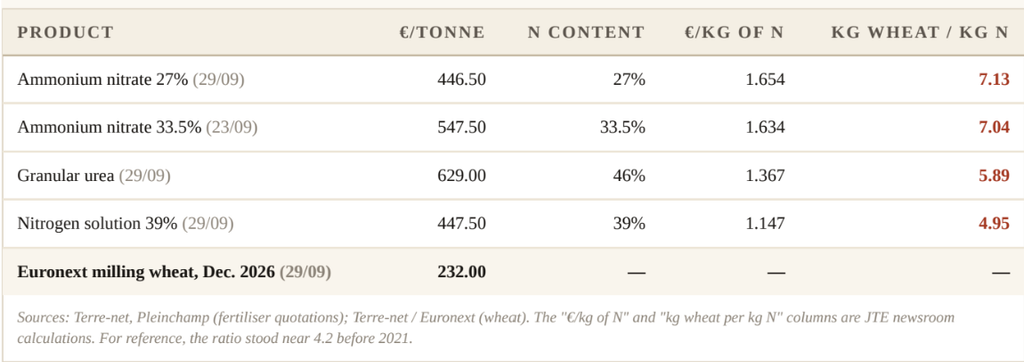
In France the quotations say the same thing in another language. Ammonium nitrate 33.5% changed hands at €547.50 a tonne ex-works on 23 September, up €7.50 on the previous print; ammonium nitrate 27% at €446.50 on 29 September (+€6); urea at €629 a tonne (+€2) and nitrogen solution at €447.50 delivered Rouen (+€2.50). Everything is rising, gently, against the season: May to September is normally the year’s low point. But a fertiliser price on its own says nothing. What the farm buys is nitrogen; what it sells is grain. That is where the picture turns. Euronext milling wheat for December 2026 fell back to €232 a tonne on 29-30 September, from €241 on
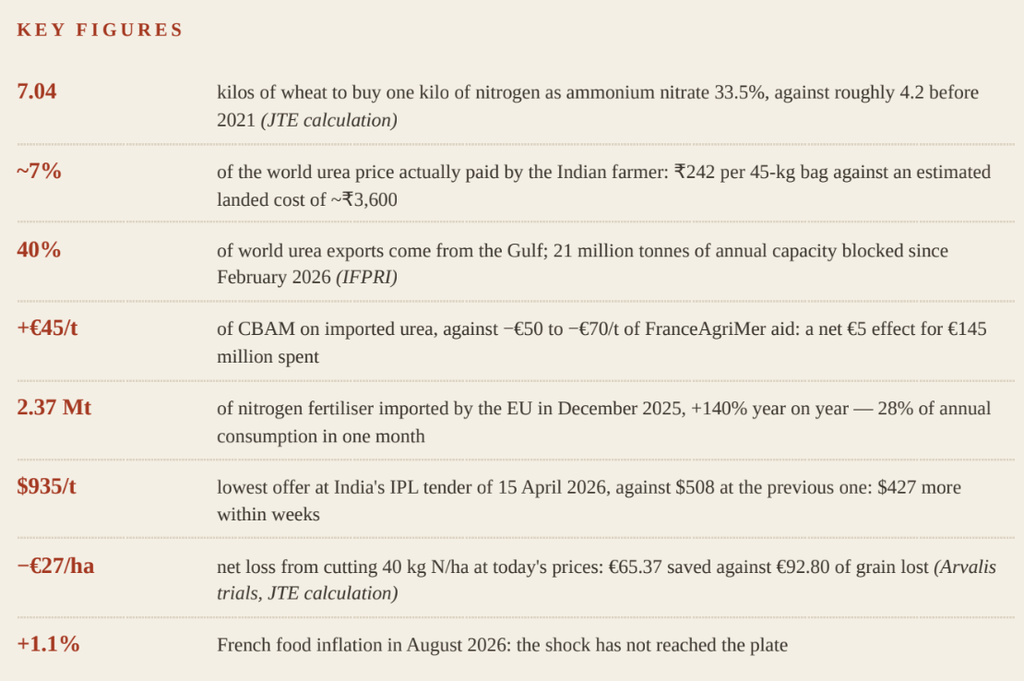
24 September; physical wheat delivered Rouen for October-December trades at the same level. Expressed per fertiliser unit, ammonium nitrate 33.5% costs €1.634 per kilo of nitrogen and the 27% grade €1.654. Divided by the wheat price, that gives 7.04 kilos of wheat for one kilo of nitrogen with the 33.5% grade, and 7.13 with the 27%.
It takes 2.36 tonnes of wheat to buy one tonne of ammonium nitrate. Before 2021, it took about 1.4.
Reconstructing the historical benchmark calls for care. In April 2026 the Normandy chambers of agriculture put
ammonium nitrate 33.5% at €607 a tonne, « 2.4 times » the levels prevailing before the 2021 surge, which places the reference around €253. With wheat at €180 over 2019-2020, the ratio works out at 4.2 kilos of wheat per kilo of nitrogen. Going from 4.2 to 7.0 is a deterioration of roughly 68% in the farmer’s purchasing power measured in the only unit that matters to him. No exchange publishes that number.
THE UNDERESTIMATED MECHANISM
The Indian farmer pays 6.7% of the world urea price Here is the figure that explains all the rest, and that appears nowhere. In India the retail price of a 45-kilo bag of urea is administered and has been frozen since 2018 at 242 rupees. In April 2026 the landed cost of the same bag was estimated at around 3,600 rupees, a press estimate consistent with a landed price near $935 a tonne, not a published figure. The Indian farmer therefore pays on the order of 7% of the world price; the remaining 3,358 rupees or so, nearly 74,600 rupees per tonne of urea are absorbed by the Indian treasury.
India consumes roughly 35 million tonnes of urea a year and accounts for close to 20% of world imports. On 15 April 2026 its IPL tender drew lowest offers of $935 a tonne CFR on the west coast and $959 on the east coast, against $508 and $512 at the previous tender from $427 and $447 more within weeks. Twenty-five bidders, offers running to $1,136, for 2,500kt sought and barely 1,300-1,500kt physically available. No private buyer anywhere would have signed those prices. A buyer who passes none of it on to his end customer will.
This is the textbook definition of inelastic demand manufactured by public policy. The scarcity signal the world price was meant to carry to a fifth of global import demand is intercepted at the Indian border and replaced by a budget line. New Delhi’s fertiliser subsidy bill, budgeted at ₹1.71 lakh crore for FY27 before the crisis, is now projected above ₹2 lakh crore; every $100 a tonne increase in landed cost adds roughly ₹29,000 crore to the bill.
The International Food Policy Research Institute quantified the mechanism in May. Its simulations give, for a severe tightening of export restrictions, a rise in world urea of $134 a tonne and DAP of $224; for an extension of subsidies to South America and South-East Asia, a rise in urea of about 5%, or $55 a tonne. In other words, at comparable fiscal cost, withdrawing a few million tonnes from world trade through an export ban raises the price 2.4 times more than spending the same sum on subsidies. Both instruments push the same way; one is simply blunter. The authors put it plainly: export restrictions « insulate domestic users from high global prices, but amplify global supply shocks by removing physical volume from the marketplace ».
The physical backdrop is real and nobody disputes it. The Gulf supplies 40% of world urea exports and 23% of DAP; the closure of Hormuz has blocked some 21 million tonnes of annual urea export capacity and 4 million tonnes of DAP.
The World Bank recorded a fertiliser index up more than 12% in the first quarter of 2026, its highest since October 2022, and forecasts +30% over the year for fertilisers as a whole and nearly +60% for urea alone. The shock exists. The question is who gets to read it.
THE ANALYSIS
Taxing and subsidising the same bag The opposing case deserves its strongest form first, because it is a good one. It runs as follows: this is a physical supply shock caused by an act of war, not a market failure; food is a necessity whose security justifies intervention; a one-year aid acts as a bridge while trade flows reorganise; and above all, cutting nitrogen would be agronomically absurd. On that last point Arvalis has published unambiguous trials, thirty of them, run from 2023 to 2025: the final 40-kilo nitrogen application at flag-leaf stage returns on average 4 quintals per hectare and 1.1 protein points. Dropping it costs precisely that.
That argument deserves to be taken seriously, because it checks out to the cent. Forty kilos of nitrogen as ammonium nitrate 33.5% cost €65.37 per hectare today. Four quintals of wheat at €232 a tonne are worth €92.80 per hectare. The saving therefore produces a net loss of €27.43 a hectare. For the cut to pay, wheat would have to fall below €163 a tonne. The deterioration in the price ratio has not yet crossed the agronomic tipping point: the economic optimum remains close to the technical one, and the dose will hold.
Which is precisely why the dominant reading reaches the wrong conclusion. The 2027 harvest will not collapse for want of nitrogen. farmdoc daily confirms it on the other side of the Atlantic: on the Illinois farms it tracks, the rate has stayed between 201 and 207 pounds an acre every year since 2015, 204 in 2025, and 51% of farms move by less than ten pounds from one year to the next, a correlation coefficient of 0.65. MRTN recommendations for 2027, computed with $5.00 corn and $900 anhydrous, come out at 181 to 204 pounds depending on the region. Nothing collapses.
The shock will not be absorbed by less nitrogen. It will be absorbed by more public money.
And every euro of that absorption keeps world demand inelastic and the world price high.
That is where the error lies, and it is Hayekian in the strictest sense. A relative price is not a cost: it is information about relative scarcity, and the sole function of the price system is to carry that information to whoever has to decide. The nitrogen-to-wheat ratio has gone from 4.2 to 7.0. That is a complete sentence, addressed to a few hundred million dispersed decision-makers: economise nitrogen where it earns least, redeploy acreage, accelerate legumes, adjust timing and splitting of applications, revisit rotations. Every one of those trade-offs depends on knowledge: a soil, a field, a contract, an outlet that no administration holds. Suppressing them with a flat cheque does not protect the farmer: it removes the information on which he would have decided.
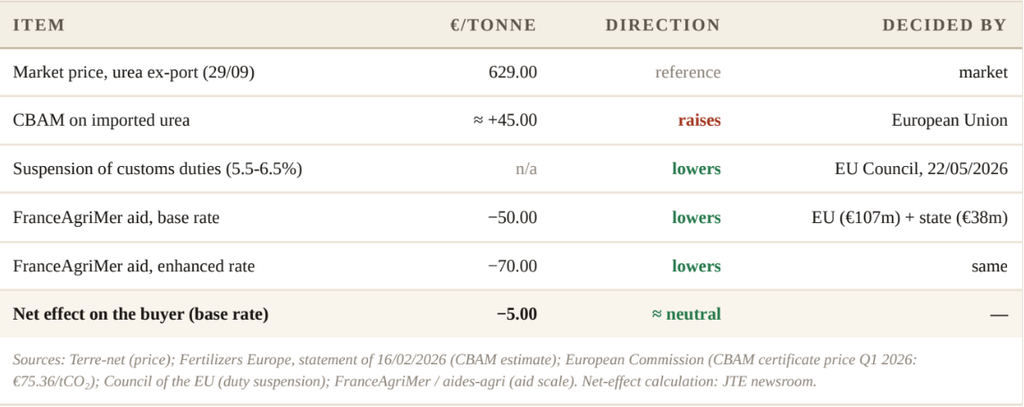
And that is exactly what the French scheme does, twice in the same direction, with unintended elegance. Since 1 January 2026 the Carbon Border Adjustment Mechanism has applied to imported fertilisers; Fertilizers Europe puts the effect at around €45 per tonne of urea, close to 8% of the farm-delivered price, with the CBAM certificate set for the first quarter at €75.36 per tonne of CO2. Since 31 July, FranceAgriMer has paid a purchase aid on straight nitrogen fertilisers of €50 a tonne, raised to €70 for young farmers and farms where fertiliser exceeds 10% of costs. The envelope: €145 million, of which €107 million from the EU crisis reserve and €38 million from the French state. The scheme was widened on 25 September: the eligible purchase window, originally closing on 30 September, now runs to 31 December 2026, the filing deadline moves with it, and the minimum payment falls from €750 to €350.
The net result for the farmer is +€5 a tonne at the base rate, +€25 at the enhanced rate. The net result for the public finances is €145 million spent to cancel a tax the European Union has just introduced. The net result for the price signal is that it has been cut twice: once upward, by a border carbon tax decided before the war and maintained during it; once downward, by a per-tonne subsidy that lowers the marginal price of the scarcest molecule exactly the same error as the 35 cents a litre of diesel granted to the fishing fleet on 22 September.
One detail of the scale deserves mention, because it reveals the logic. The aid is capped at 50% of the tonnage
purchased in 2025. This is not income support: it is quantity support, indexed on past consumption. It mechanically rewards whoever consumed most before the shock and penalises whoever had already economised. A decoupled payment of the same amount, a flat per-hectare transfer, or simply dropping CBAM on fertilisers would have supported the same income while letting the relative price do its work. The opposite was chosen.
THE EUROPEAN CONTEXT
A dependence created by policy, then treated by policy
France now imports more than 60% of its nitrogen fertiliser, and Europe is in a comparable position. That dependence is no geological accident: ammonia is made from natural gas, and the cost of European gas mechanically makes Europe the world’s marginal producer. Yara, the largest European maker, paid $15.8 per MMBtu on a European weighted average in the second quarter of 2026, against $13.7 a year earlier. For now the group is winning: EBITDA excluding special items of $906 million in Q2, up 39% from $652 million, and net income attributable to shareholders of $543 million (+32%), despite deliveries down 14% at 7.108 million tonnes and ammonia production down 8% at 1.608 million tonnes. Less volume, far more margin: the signature of a supply-constrained market.
The most revealing European figure of the year lies elsewhere. In December 2025, on the eve of CBAM entering force, the Union imported 2.37 million tonnes of nitrogen fertiliser in a single month, an all-time record, up 140% on December 2024, and on its own close to 28% of annual European consumption (8.3 million tonnes in 2023).
Cumulative imports from July 2025 to January 2026 nearly doubled year on year. That mountain was not bought because the market needed it: it was bought because a fiscal deadline had been announced. The pre-buying masked the tension through the first half of the year, then ran out. What the regulatory calendar cost in volatility will be measured later.
The European response followed the same path as the national one: on 22 May 2026 the Council suspended for one year the 5.5-6.5% customs duties on nitrogen fertilisers not already duty-free, for an estimated saving of €60 million, under a quota set at 2024 MFN volumes plus 20% of what Russia and Belarus exported to the EU in 2024 both countries being excluded from the benefit. So the Commission, in the same year, imposed a border carbon tax on fertilisers and abolished the customs duties on the same fertilisers.
For the longer term, France has announced a €2 billion ten-year investment plan, of which €620 million in public
support, to raise national nitrogen output by 20% by 2032, around three sites: LAT Nitrogen at Grand-Quevilly, Yara at Le Havre and FertigHy at Languevoisin-Quiquery. The intention is defensible. The date says everything: capacity will arrive in 2032 for a shock that struck in 2026. This is no reproach to the engineers — an ammonia unit takes five to seven years to build, it is a reminder that the useful decision was taken, or omitted, fifteen years ago.
That leaves the consumer, who has seen nothing yet. The FAO Food Price Index stood at 133.3 points in August 2026, up 1.9% on the month and 2.5% on the year, still 16.8% below its March 2022 peak; the cereals component is at 116.3 (+2.2%). In France, Insee measured food inflation in August at just +1.1% year on year — against +5.9% for fresh produce and +16.7% for energy. Processed food, in other words, has not moved. The lag is normal. IFPRI puts the transmission of energy costs to the shelf at three to six months, with effects persisting twelve to eighteen months, and the nitrogen bought this autumn will show up in a July 2027 harvest and then in an autumn 2027 loaf. That is the lag of one cropping season: eighteen months between the price and the plate.
SOURCES
- Terre-net, fertiliser quotations — urea and ammonium nitrate 27%, prints of 29 September 2026. terre-net.fr
- Pleinchamp, ammonium nitrate 33.5% quotation, print of 23 September 2026. pleinchamp.com
- Terre-net, physical market for milling wheat and maize, prints of 28 September 2026. terre-net.fr
- Réussir / La Dépêche, « Marché des céréales et du sucre du 16 au 23 septembre 2026 ». reussir.fr
- DTN / Progressive Farmer, « Fertilizer Prices Rise for Six of Eight Major Fertilizers », 23 September 2026. dtnpf.com
- DTN / Progressive Farmer, « Fertilizer Prices Continue Lower for 6 of 8 Major Nutrients », 16 September 2026. dtnpf.com
- farmdoc daily (University of Illinois), Schnitkey, Paulson, Gentry and Zulauf, « Changing Nitrogen Rates on PCM Farms: Implications for 2027
Nitrogen Decisions », 29 September 2026. farmdocdaily.illinois.edu - World Bank Data Blog, John Baffes and Kaltrina Temaj, « Fertilizer prices surge as Strait of Hormuz disruptions tighten supplies », 14 May 2026.
blogs.worldbank.org - IFPRI, Shawn Arita, Ming Wang and Joseph Glauber, « How fertilizer policies could exacerbate Hormuz price shocks », 22 May 2026. ifpri.org
- IFPRI, Rob Vos, « Iran war: From fertilizer to food crisis? », 2 July 2026. ifpri.org
- FAO, Food Price Index, August 2026 update released 4 September 2026; next release 2 October 2026. fao.org
- Fertilizers Europe, « Statement on the European fertilizer market », 16 February 2026 (CBAM effect estimated at ~€45/t of urea; EU imports of
December 2025). fertilizerseurope.com - European Commission, DG TAXUD, CBAM definitive regime in force since 1 January 2026; first certificate price published 7 April 2026 at
€75.36/tCO2. taxation-customs.ec.europa.eu - Council of the European Union, one-year suspension of customs duties on nitrogen fertilisers, 22 May 2026. euperspectives.eu
- FranceAgriMer, 2026 straight nitrogen fertiliser purchase aid (rates, caps, envelope, calendar as widened on 25 September 2026). aides-
agri.beta.gouv.fr - Perspectives Agricoles, « Engrais azotés : aide de 50 €/t et relance de la production française » (€145m envelope, €620m plan, 2032 target).
perspectives-agricoles.com - Arvalis, « Azote sur blés : pas de baisse de dose à prévoir malgré les prix », 23 April 2026. arvalis.fr
- Chambres d’agriculture de Normandie, « prix des engrais azotés » market note (April 2026 reference and pre-2021 comparison).
normandie.chambres-agriculture.fr - Yara International, second-quarter 2026 report, 17 July 2026. yara.com
- Afriqom, « India urea prices hit record highs amid tight supply » (IPL tender of 15 April 2026, offers received). afriqom.com
- Swarajya, « How India beat the 2026 fertiliser crisis — and what it will cost us » (administered bag price, landed cost, subsidy bill).
swarajyamag.com - Insee, « En août 2026, les prix à la consommation augmentent de 2,4 % sur un an », Informations Rapides. insee.fr
- Investrade, « Market Review: September 29, 2026 » (closes: S&P 500 7,671, Nasdaq 26,797, Dow 51,350, 10-year UST 5.263%, 30-year 5.61%,
WTI $89.38, Brent $102.59, consumer confidence 81.9, JOLTS 7.079m). investrade.com