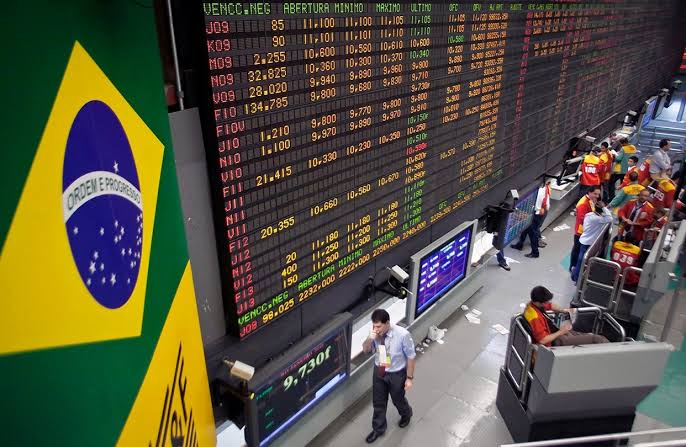
Brazil’s stock market had its best day since March 2020 on Monday, after Flávio Bolsonaro finished first in the presidential election’s first round. The rally bets on a change of fiscal regime after the 25 October runoff. But the number that will decide Brazil’s next four years is not on any ballot: the state spent 8.86% of GDP on interest over the past year. Whoever wins inherits that bill.
I. The fact and its figures
On Sunday 4 October, with practically all ballots counted, Flávio Bolsonaro (PL) took 47.03% of valid votes against 45.16% for the incumbent, Luiz Inácio Lula da Silva (PT) a gap of 1.87 points, with the runoff set for Sunday 25 October. The final polls had shown Lula ahead; the son of the former president beat his polling average by more than four points.
Markets answered on Monday. The Ibovespa closed at 206,911.89 points, up 7.70%, after touching an all-time intraday high of 209,605.70. The dollar fell 4.12% to R$5.0022. The rally was concentrated in the most domestic and most rate-sensitive names: Magazine Luiza +24.18%, BTG Pactual +22.52%, Bradesco +13.57%, Banco do Brasil +11%, Petrobras preferred shares +8.19%. Exporters such as Vale and Gerdau slipped.
The most telling move was in interest-rate futures. The DI contract for January 2035 fell 133 basis points in a single session, from 14.131% to 12.8%; the January 2028 contract fell 84 basis points to 12.665%. In one day, the market cut the expected cost of Brazilian money for the next decade by more than a full point. That is not an equity story. It is a bet on the solvency of the state.
II. What the market is underestimating
Most foreign coverage frames the vote as a referendum on spending, and the rally as relief that a more orthodox government may take over. Look at the latest fiscal statistics from Banco Central do Brasil, published on 30 September, and the picture is different. Over the twelve months to August, the public sector’s primary balance — revenue minus spending before interest was a deficit of R$82.1 billion, just 0.62% of GDP. Over the same period, nominal interest cost R$1.18 trillion, or 8.86% of GDP, up from 7.61% a year earlier. The nominal deficit reached 9.48% of GDP.
In other words, more than nine-tenths of Brazil’s deficit is interest. The monthly figures make it vivid: in August alone, the primary deficit was R$10.0 billion, the best August since 2021, while interest cost R$105.9 billion, up 42.6% on August 2025. Gross general government debt rose to 82.9% of GDP, its highest in five years; net debt reached 69.3%, a record in a series that starts in 2001.
The reason is the price of money. The central bank’s policy rate, the Selic, stands at 13.75% after a fifth consecutive quarter-point cut in September. With twelve-month IPCA inflation at 4.22% in August, the real policy rate is about 9% — one of the highest in the world. Divide the interest bill by net debt and the average nominal cost of the state’s borrowing comes out at roughly 12.8% (calc. JTE). Nominal GDP, on the other hand, is growing at about 6.2% a year: 1.9% real growth over the four quarters to June, according to IBGE, plus 4.2% inflation.
When the interest rate on the debt runs more than six points above the growth of the economy, debt grows on its own. The textbook formula gives the primary surplus needed simply to keep the debt ratio stable: debt × (interest rate − growth) / (1 + growth). With Brazil’s figures, that is a primary surplus of about 4.3% of GDP (calc. JTE). The country runs a deficit of 0.6%. The gap is close to five points of GDP — around R$650 billion a year. No plausible spending cut closes that alone. The market knows this, which is why Monday’s most important move was in the DI curve, not in bank stocks.
| Average cost of net public debt | Primary surplus needed to stabilise debt (% of GDP) | Gap vs current primary (−0.62%) |
|---|---|---|
| 12.8% (current, implied) | 4.3% | 4.9 pts |
| 11% | 3.1% | 3.8 pts |
| 10% | 2.5% | 3.1 pts |
| 9% | 1.8% | 2.5 pts |
III. The deeper analysis
The table shows where the real lever lies. Every point shaved off the average cost of debt reduces the required effort by roughly 0.65% of GDP. A government that convinces lenders it will not inflate or default away its debt gets a fiscal adjustment from the market for free. That is what Monday’s 133-basis-point drop in the long DI was: the market offering Brazil a cheaper price on its debt, conditional on the policy that follows.
This is where the liberal reading matters. Interest rates are prices. A real Selic of 9% is not a whim of the central bank; it reflects what savers demand to lend to a state whose spending rules have been loosened repeatedly and whose debt keeps rising. The Copom’s own minutes say that weaker fiscal discipline and slower reforms could raise Brazil’s neutral rate, and that inflation expectations remain above target at every horizon: the Focus survey of forecasters expects 4.9% in 2026 and 4.3% in 2027, against a 3% target. Brazil’s chronically high interest rate is the price of fiscal discretion. Reduce the discretion a credible, binding rule on spending growth, enforced in law rather than renegotiated every budget and the price falls.
The best counter-argument. The strongest case against this reading comes from those who blame the central bank, not the Treasury. If the interest bill is the problem, they argue, the quickest fix is to cut the Selic faster: inflation is back under the 4.5% ceiling of the tolerance band, August even brought a monthly deflation of 0.32%, and growth is slowing to around 1–1.5% according to local bank forecasts. On this view, an over-cautious central bank is creating the fiscal problem it then blames on politicians, and a government that pressed for lower rates would be acting rationally.
The argument has a real basis: monetary policy does drive the interest bill, and the central bank’s projections, 5.2% inflation for 2026, 3.2% still in early 2028 suggest that a long period of restrictive rates. But it confuses the policy rate with the cost of debt. Brazil’s long-term rates were above 14% before the election, higher than the Selic itself: lenders were demanding a premium for the risk of the fiscal path, not for the central bank’s stance. A political push for faster cuts would most likely raise long rates, weaken the real and lift inflation expectations exactly the sequence Brazil has lived through before. The rally of 5 October happened because the market saw a chance of the opposite. Rates come down durably when the state stops needing them to be high.
Nor is this a story about one candidate. Both campaigns have been light on fiscal detail. Advisers around Flávio Bolsonaro are reported to have discussed a market-friendly consolidation plan with banks; Lula’s camp is seen as more likely to tighten slowly. Markets are pricing intentions. The arithmetic will judge results, and it does not care who wins on 25 October.
IV. The European context
For Europe, Brazil is now much more than an emerging-market trade. The EU–Mercosur interim trade agreement has applied provisionally since 1 May 2026, with Brazil, Argentina, Uruguay and Paraguay, creating a market of more than 700 million consumers, even though the European Parliament asked the EU Court of Justice in January to rule on its legality. European exporters of cars, machinery, chemicals and wine therefore have a direct interest in the strength of the real and in Brazilian demand: a stronger currency and lower interest rates make their goods more affordable in Brazil.
There is also a lesson in reverse. Europe has its own countries where interest absorbs a rising share of public spending, starting with France. Brazil shows how fast a market can reprice a sovereign when it believes the fiscal regime will change, a 133-basis-point drop in one day and how slowly the bill falls if belief is not followed by action. European finance ministers who think high debt costs are only a monetary-policy problem should look at São Paulo.
V. What to watch
- 25 October — the runoff. A gap of 1.87 points after the first round leaves the outcome open; a Lula comeback would test how much of Monday’s rally was conviction and how much was positioning.
- The long DI curve. If the January 2035 contract holds below 13% after the vote, the market is granting the next government a cheaper cost of debt in advance.
- 3–4 November — Copom. Short-term rates priced only about a 15% chance of a larger Selic cut; a faster easing path would need lower inflation expectations, not just a stronger real.
- The first fiscal announcements of the winner. A binding rule on spending growth would matter more than any one-off measure.
- Monthly central bank fiscal data. The interest bill (8.86% of GDP) and gross debt (82.9%) are the two lines that say whether the trajectory is turning.
Key figures
- 47.03% vs 45.16%: Flávio Bolsonaro vs Lula, first round of 4 October
- +7.70%: Ibovespa on 5 October, to a record 206,911.89 points
- R$5.0022: dollar close on 5 October (−4.12%)
- −133 bp: January 2035 DI future in one session (14.131% → 12.8%)
- 13.75%: Selic after the September cut
- 4.22%: IPCA inflation over twelve months to August
- 8.86% of GDP: nominal interest over twelve months to August (R$1.18 trillion)
- −0.62% of GDP: primary balance over the same period
- 82.9% / 69.3%: gross and net public debt, % of GDP
- ≈ 4.3% of GDP: primary surplus needed to stabilise debt (calc. JTE)
| Brazil’s public accounts (12 months to August) | 2025 | 2026 |
|---|---|---|
| Nominal interest, R$ | 946.5 bn | 1,182 bn |
| Nominal interest, % of GDP | 7.61% | 8.86% |
| Primary balance, % of GDP | — | −0.62% |
| Nominal deficit, % of GDP | — | 9.48% |
| Gross debt, % of GDP (August) | — | 82.9% |
Sources
- The Rio Times — First-round results (TSE count)
- CNN Brasil — Ibovespa, dollar and DI on 5 October 2026
- O Tempo — Central bank fiscal statistics, August 2026
- Gazeta Mercantil — Public-sector interest, August 2026
- Agência Brasil — Copom minutes, September 2026
- The Rio Times — Copom minutes: projections and neutral rate
- Jornal de Brasília — IPCA, August 2026 (IBGE)
- IBGE — GDP, second quarter 2026
- VanEck — Brazil election update: notes from São Paulo
- KPMG — EU-Mercosur provisional application from 1 May 2026
- White & Case — EU-Mercosur pending CJEU opinion