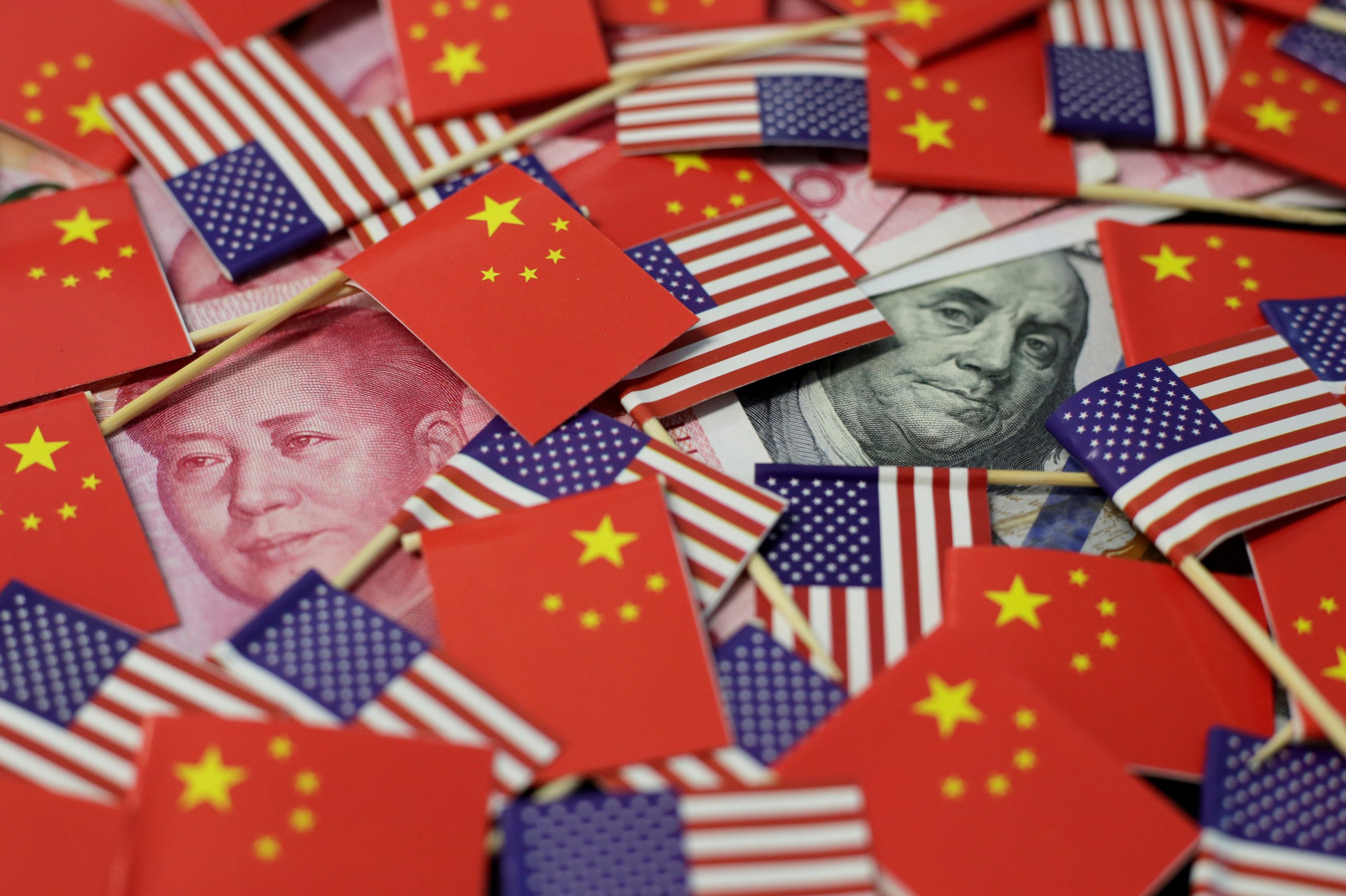
Since the late 2010s, the world’s two largest economies have been locked in a trade confrontation whose ripple effects extend far beyond their borders. Tariffs, technology restrictions, export controls: a breakdown of a conflict reshaping global trade.
How It All Started
The turning point dates back to 2018, when the United States imposed tariffs on several hundred billion dollars’ worth of Chinese imports, citing a structural trade imbalance and forced technology transfer practices. Beijing retaliated with symmetric measures, opening a cycle of reprisals that extended well beyond consumer goods alone.
This conflict is not just about trade figures. It is part of a broader rivalry for technological and industrial supremacy in the 21st century such as semiconductors, artificial intelligence, electric vehicles, rare earths.
The Tariff Mechanism
A tariff is a tax levied on an imported product as it enters a country. Contrary to popular belief, it is not the foreign exporter who pays it directly, but the importer — often a company based in the country imposing the tax. This additional cost is then passed on, in whole or in part, to the final consumer through higher prices, or absorbed through lower profit margins for the companies involved.
This is why tariffs, often presented as a weapon against a trade rival, carry a real domestic cost: they raise prices for households and businesses in the country that imposes them, while seeking to protect certain industries considered strategic.
The Impact on Global Value Chains
Multinational companies have largely built their production chains on the assumption of a stable and predictable globalization. The US-China standoff has upended that calculation. In recent years, we’ve seen a shift toward diversifying supply chains, sometimes called « friend-shoring » or « nearshoring ». As companies seek to reduce dependence on a single supplier country by spreading production across several geographic zones, notably Southeast Asia, India, or Mexico.
This shift comes at an economic cost: geographic specialization optimized for efficiency gives way to a logic of resilience, which is often more expensive in the short term.
Three Scenarios Going Forward
Continued escalation: new technological and tariff restrictions, with a growing risk of the global economy fragmenting into distinct blocs.
Negotiated stabilization: a tacit status quo in which both powers hold their positions without further major escalation, while reassessing their respective interests.
Targeted sectoral decoupling: rather than a total rupture, a gradual separation limited to sectors deemed strategic (advanced semiconductors, AI), while trade continues on less sensitive goods.
Key Takeaway
The US-China trade rivalry is not a simple tariff dispute: it is a lasting reshaping of global economic balances, with direct consequences for prices, supply chains, and corporate investment decisions. Understanding its mechanisms is essential to reading the economic news of the years ahead.